
🚀 Skyrocket team connection after only ONE day
How connected is your team?
This is a really important question because teams being connected is the foundation for psychological safety in the workplace.
It's the foundation for people being contented at work -- and even happy at work if they can be.
It is the foundation for productive output of a team and getting the results that you need to get for your organization.
When team leaders reach out to me asking for a team building retreat, I ask them what they mean by that. What is their expectation of team building?
What Team Building Really Means
Team building to me is not just about going mini golfing or going on a boat trip or doing a painting class together: it's about connecting at a deeper level.
And usually, especially for the purpose-driven leaders that I work with, that deeper level connection is related to the foundational purpose of the organization where they're working.
I try to run retreats that are geared around helping people:
- learn things together,
- do productive work together, and
- at the same time, get more self-awareness and team awareness so that they can connect and do all of these important pieces for the organization that they need to.
But How Do You Know It Actually Works?
There have been many team retreats and sessions that I've run where one of the main objectives was not team connection or collaboration, but it was still a piece that I measured.
Yes, you can measure connection simply by asking people beforehand in the pre-retreat survey: "How connected do you feel to the members of your team?"
And then at the evaluation at the end of the retreat: "How connected do you feel?"
I get dramatic results and improvements every single time.
The Data: Real Results from Real Teams
Below is a little bit of data for those data nerds we've got out there. We appreciate you! 😜
Example 1: Dramatic Improvement with a Booster
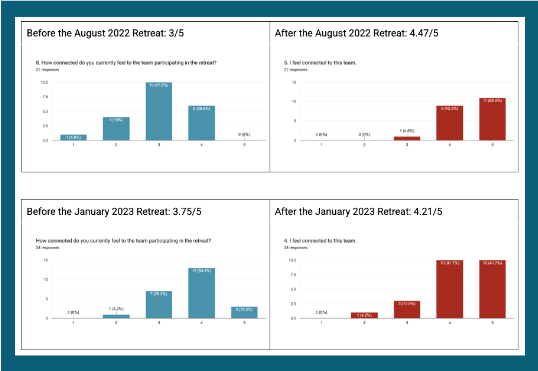
Here's an example of an organization where we held a 1.5-day retreat for their management team in August, and then we held a 1-day booster retreat five months later.
Before the August retreat, this was the average response for "How connected do you currently feel to the team participating?":
3 out of 5 (with 5 being strongly connected and 1 being strongly disconnected), which means neutral levels of connection.
After only a 1.5-day retreat, we had dramatic improvements in connection.
The score jumped to 4.47 out of 5, which was really great to see.
3/5 --> 4.47/5 after only 1.5 days of a retreat!
Five months later we held a booster retreat. You'll see that over those five months the sense of connection went down to a 3.75, so it was not nearly as low as it was before, but after only a few months with no intentional activities focused on team connection, the sense of connection did drop.
After a one-day booster retreat, connection went back up again.
Example 2: Series of Interventions
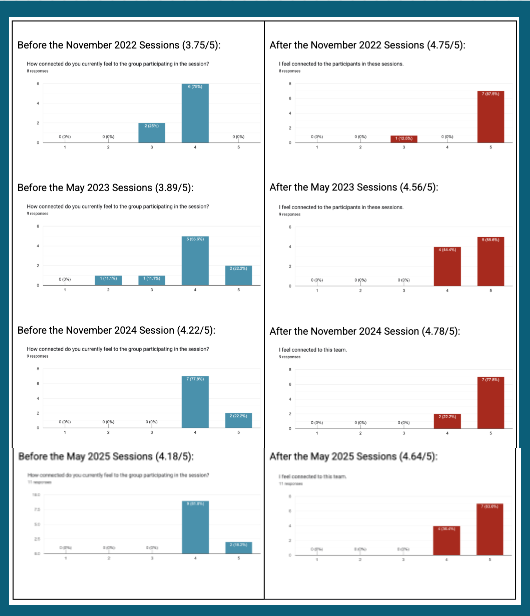
This is another organization where we had a series of interventions.
Before the November 2022 session, their connection level was 3.75 out of 5.
After only a one-day session, their sense of connection jumped to 4.75 out of 5.
Over the course of six months, the connection levels dropped again (though not as low as it was before the first retreat).
Then again, after a one day intervention, they were all feeling connected -- either Somewhat Connected or Very Connected.
With that same group of people, between each session the connection would drop a little (though never as low as the initial measure), and it would go up again after a day's retreat.
Experiences like team retreats, combined with strong consistent leadership and commitment across the management team, catapulted this team to being a strong management team that continues to prioritize their connection and collaboration.
Example 3: Organization-Wide Shift
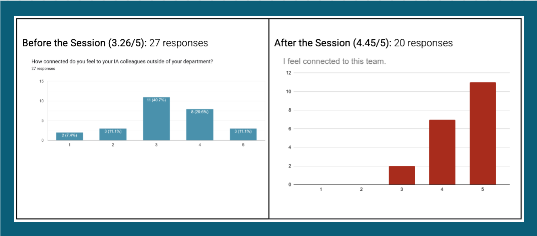
This is another client organization. Across the organization, they had an average of feeling more or less connected.
By the end of the two-day retreat it changed dramatically, to most of the people feeling Very Connected.
Example 4: From Disconnected to Very Connected
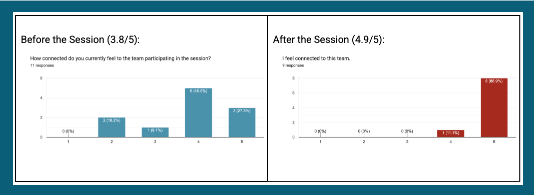
Then this is yet another organization where you'll see that it went from an average of 3.8/5, with two of the eleven people actively feeling disconnected from the group, to all of them feeling connected -- and all but one feeling Very Connected.
3.8/5 --> 4.9/5 after one day of a retreat. Amazing!
What This Means for You
This is useful to show that you can really do a lot in terms of building connection.
You may think that connection is hard to evaluate and measure, but you can measure it.
Then, you can use that as a foundation to make a big difference in the connection that your team feels.
What's even more interesting is that for all of these teams, their main retreat objectives weren't even focused on connection.
However, by learning together, working on real challenges together, building awareness together—they were able to improve their sense of connection.
Almost all of these retreats were one-day interventions with teams. Not multi-day, intensive programs.
Just one day of intentional, purposeful work together can have a massive impact on your team's connection, setting them on a better path for collaboration and productivity.
Why Connection Matters
If you've identified connection as an important piece in building your team's ability to:
• Retain talent
• Get productive work outputs
• Feel happy while at work
...then please reach out so we can talk about what might work for you.
To get started with me, your first step would be to book a Discovery Call here.
(If the process of doing that seems intimidating, I'd encourage you to take a peek at my article "Hiring a Consultant Shouldn’t Be Hard — Here’s How I Make It Easy.")
If you're not quite ready for that, feel free to get to know me better from a distance by joining my e-newsletter or following me on LinkedIn.
Looking forward to it!
--Megan

About Megan E. Mozina (she/her)
As Owner and Principal of Cresta Solutions, I serve as a strategic partner to purpose-driven leaders when they need their teams to innovate and collaborate in order to deliver on strategic change initiatives. To get there, I serve as a facilitator, consultant, and executive coach who leverages expertise in Creative Problem Solving, Team Building, Organizational Change Management, and Strategic Initiatives to ensure my clients get innovation-focused results. I bring over fifteen years of diverse experiences with purpose-driven organizations across four continents. To ensure that changes work and goals are achieved, I use my facilitation superpower to supercharge team collaboration and output.
I hold a Masters from The George Washington University’s Graduate School of Education & Human Development and a Bachelors from the University of Wisconsin-Madison. I am certified in Change Management, Strategic Planning, and Creative Problem Solving (FourSight®), with additional formal training in Lean Process Improvement, Project Management, and People Management. I regularly present at regional and international conferences on topics such as facilitation, change management, and project leadership. I’m proud to have been a teacher in South Korea and a Peace Corps Volunteer in Honduras.
I’ve lived in five countries, so while I bring my Midwestern friendliness, work ethic, and accent everywhere I go, I see the world through a global perspective. I consume dark chocolate daily, can talk about books all day, and think that Lake Michigan might be my soul mate.
Learn more about my story here: https://www.crestasolutions.com/about.
Book a Discovery Call!
Sign up for a 30-minute no-pressure chat with Megan.
Blog Author

Megan Mozina
(she/her)
Hello, there! As Owner and Principal of Cresta Solutions, I help catalyze your team to solve that nagging problem. I serve as a strategic partner to purpose-driven leaders whose smart, busy team has the potential to solve any problem with the right framework and approach. Reach out to explore collaboration!
Stay connected with news and updates!
RECENT POSTS
